
It started as one officer’s plan for a shrimp spaghetti dinner and a check for Baton Rouge. Ten years on, United in Blue tries to catch Mississippi first responder families in the gap nobody plans for.
Zach Grady was in a Barnes & Noble, scrolling Facebook, when he saw the news from Bay St. Louis: Sgt. Steven Robin and Officer Branden Estorffe had been shot and killed the night before. Grady had worked narcotics at the D’Iberville Police Department with Estorffe’s father, Ian.
“It was really like a gut punch situation,” Grady said. Right then, he decided the group he had started years earlier had to come back.
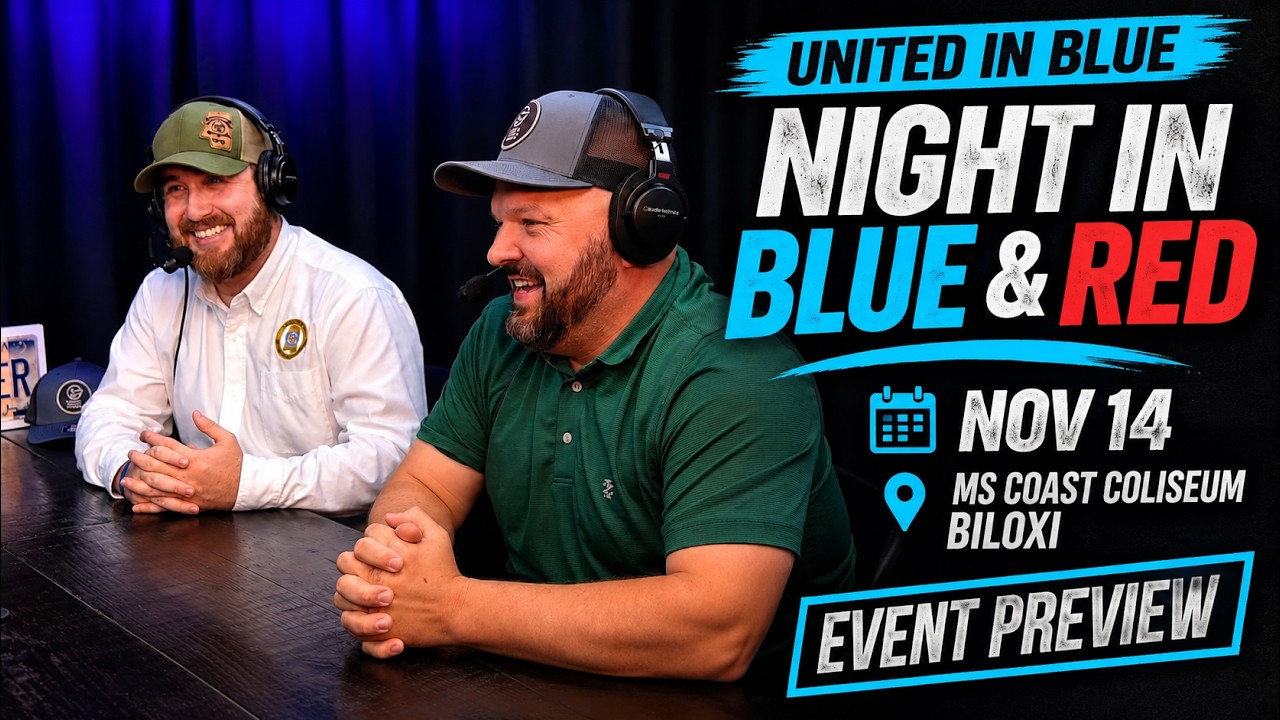
That group is United in Blue, a volunteer-run Mississippi nonprofit for the weeks after a first responder doesn’t come home, when grief arrives alongside the car note and the mortgage. Grady is its executive director. On November 14, it marks 10 years with its gala, A Night in Blue & Red, in its biggest room yet: the Mississippi Coast Coliseum and Convention Center in Biloxi.
Grady came by the studio with Lynn Bentz, an officer with the Mississippi Department of Agriculture and Commerce’s law enforcement branch who served on one of the group’s selection boards this year.
Here’s the night at a glance:
- When: Saturday, November 14, 6 to 9 p.m. Doors open at 6, and the program starts at 6:45 and runs about an hour.
- Where: Mississippi Coast Coliseum and Convention Center, Biloxi
- Tickets: $50, or $25 for first responders, online through the code on the flyer below or at the door
- Dress: Coastal casual or cocktail
- Inside: Food, a silent auction, raffles, a cash bar and the first responder band No Plain Jane
- Can’t make it: Donate, volunteer or give auction items through United in Blue on Facebook.

🍤 A dinner idea that snowballed
It started with another city’s worst day. In 2016, six officers were shot on a single day in Baton Rouge. Grady, then a D’Iberville officer under Chief Wayne Payne, kept thinking about what that would do to a community like his.
He pitched the chief a shrimp spaghetti dinner that might raise $10,000 for the families. “When you don’t know what else to do, you try to do something,” Grady said.
It snowballed. Bobby Carter, then with the Golden Nugget Casino, offered the ballroom. Chief Payne wanted every agency in, so Grady recruited departments from the west side of Hancock County to the east side of Jackson County and built a board of roughly 20 to 25 people.

Over a thousand people came, and every Baton Rouge family got a $10,000 check. People asked for an encore every year. For years, nothing came of it, until that day in the bookstore.
💵 The gap nobody plans for
When United in Blue came back, it served first responders across Mississippi. Grady boils the mission down to one question: how would he want the community to treat his family if he went to work a shift and never came home?
Much of the answer is money. Between a death and any insurance or benefits there’s a gap, and many families were already stretched thin. “First responders do not make enough money,” Grady said.
He told of a coast spouse whose husband had carried the family’s health insurance. Weeks after he was killed, their baby girl got the flu with no coverage. A local doctor saw her at no cost, and the community covered the prescriptions.
Help doesn’t wait for a death. First responders hurt on duty, or whose children are seriously ill, can apply. Two years ago, two police officer parents got $10,000 as their young son fought terminal brain cancer. Last year it went to a young deputy with stage three breast cancer. This year’s gifts will be announced at the gala.
The only thing you guaranteed is a good send off when you die.
Lynn Bentz, Mississippi Department of Agriculture and Commerce
🤝 No paychecks, just people
None of it runs on paychecks. To restart the group, about five people met upstairs at Pepe’s to set it up as a 501(c)(3). Grady credits Leonard Bentz, Lynn’s father, who never wants credit, with helping him build the team.
Lynn started by sitting in on meetings, by his own account a nobody who wanted to listen. After that year’s gala, he texted Grady that he would do whatever it took. Seeing people turn out for those families, he said, makes you want to give more.
Grady is blunt that “one person could not pull this off.” Sponsors and the silent auction bring in over $100,000 a year, and organizers say all of it goes to the mission. Premier sponsors like Keesler Federal Credit Union return every year, and mom-and-pop shops still write $500 or $1,000 checks. Keesler also helped grow the scholarships for first responders’ children from five $1,000 awards to five $2,000 awards.

🇺🇸 The humanity behind the badge
Money is half the work. The other half is remembering the fallen as people. Grady stayed up until two or three in the morning hunting for something better than the usual portrait in Class A’s beside a flag.
He found Heroic Hands, a Florida business that makes wooden flags. Families send everyday pictures of their loved one with their kids, and the maker sets them in epoxy where the stars go. Last year, one spouse collapsed to the floor when she saw her husband’s picture on the flag.
People see a gun, a badge and authority, and as Grady put it, too often “they don’t see the humanity behind the badge.”
This year adds a Wall of Heroes, an idea from the group’s new president, Carla Pope, showing every first responder United in Blue has honored. This year’s honorees are Deputy Michael Jimerson and Deputy Joshua Brashears of the Jackson County Sheriff’s Office, Investigator Andretta English of the Forrest County Sheriff’s Office and Deputy Richard A. Haggard of the Lee County Sheriff’s Department.

Last year the group also honored officers killed decades ago. Grady hopes it has to keep going back into the archives every year, because that would mean no new names.
🏟️ A bigger room every year
The gala keeps outgrowing its rooms: the Golden Nugget in 2016 and 2024, then a jam-packed IP last year. Grady once pictured moving it around the state, but the crowds called for bigger venues.

One thing changes at the Coliseum. Police cars can’t come inside, so organizers are planning a display outside with fire trucks and police cars.

Inside, ROTC members from D’Iberville High School will seat guests. The program honors the families of the fallen, the scholarship winners and this year’s families in need, and presents Officer, Fireman, Dispatcher and Volunteer of the Year, plus the Guardian Award for the top first responder. The raffle includes a suppressor from High Caliber Pawn, and a Heroic Hands gun box that hangs like a flag and opens by remote will be on display.
Next, Grady wants north, central and south chapters so help can reach a family five hours away fast, and someday the reach of national groups like Tunnels to Towers. “We’re starting to see it grow wings,” he said.
Ten years ago, it was a plan for shrimp spaghetti and a check for Baton Rouge. On November 14, it moves into the Coliseum, so the next family to get that kind of news doesn’t face the gap alone.