Mississippi Just Doubled Its Artificial Reef Footprint in the Gulf
Mississippi just made one of the biggest artificial reef moves the state has seen in years.
The Mississippi Department of Marine Resources recently acquired permits for two new offshore artificial reef sites: Mississippi Reef Complex 1 and Mississippi Reef Complex 2. Together, those two areas add roughly 16,575 acres of newly permitted artificial reef space in the Gulf of Mexico — almost 26 square miles of new reef bottom.
That is not just another reef drop. According to Travis Williams, artificial reef director for the Mississippi Department of Marine Resources, Mississippi’s existing offshore fish havens total around 15,000 acres. With these two new reef complexes, the state has essentially doubled its artificial reef footprint.
For Gulf Coast anglers, charter captains, conservation-minded fishermen, and anyone who cares about the future of Mississippi’s offshore habitat, that is a major announcement.
Travis Williams serves as the artificial reef director at DMR, and Trevor Moncrief is the marine fisheries director for the department. Both joined Brown Water Banter to talk about what has been built, what is coming next, and why Mississippi’s reef program is entering a much bigger phase.
🎥 Watch the Full Conversation
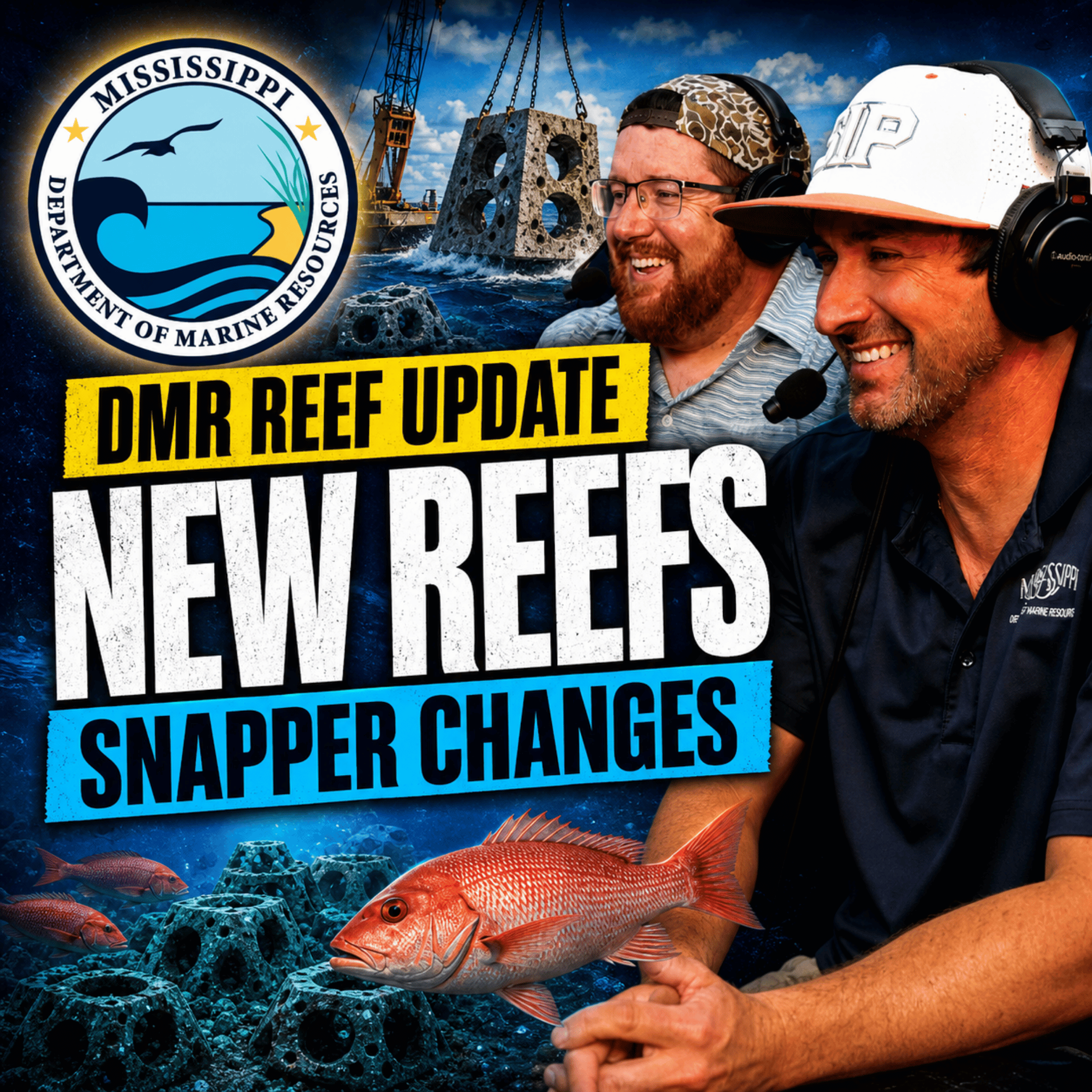
Hear the full discussion on Mississippi’s new offshore reef complexes, Katrina Key, inshore reef enhancements, reef permits, vessel deployments, and what is coming next for Gulf Coast anglers.
🌊 Two New Offshore Reef Complexes
The biggest news from the conversation was the addition of two newly permitted offshore reef sites.
Mississippi Reef Complex 1 is located adjacent to FH 13 on the west side. It covers approximately 11,500 acres and helps fill in a large area near existing fish havens, stretching toward FH 1 on one side and FH 2 on another.
Mississippi Reef Complex 2 is also adjacent to FH 13, but on the south side. That site adds a little over 5,000 acres.
Together, the two new reef complexes total about 16,575 acres. Williams described it as almost 26 square miles of newly permitted artificial reef space.
That number matters because artificial reef work is not just about sinking one boat or dropping one pile of concrete. The footprint determines how much room the state has to build habitat over time. More permitted reef bottom means more opportunities for future deployments, more room to use concrete pipe, culverts, power poles, reef modules, and other suitable material, and more potential structure for fish to use.
Williams said these are the newest offshore reef areas he has seen during his 20 years with the agency. That alone says how significant this is.
🚢 Why This Matters for Offshore Fishing
For fishermen, the practical meaning is simple: more reef space creates more potential habitat.
Much of the Gulf bottom off Mississippi is soft, flat, and muddy. Artificial reefs add hard structure where bait can gather and where fish can feed, hide, and move through the system. Over time, those reef sites can become productive areas for both recreational and charter fishermen.
But from the DMR side, the value is even bigger. A newly permitted reef complex gives the state a legal, mapped, approved area where material can be placed as funding and opportunities become available.
Williams explained that $4.5 million of the current project is aimed at offshore artificial reef construction. A large part of that money will be used to clear material from the DMR’s Gulfport staging site, where the department collects materials of opportunity like concrete pipes, culverts, manholes, boxes, and concrete power poles.
That means Mississippi does not just have new reef space on paper. The state also has material waiting to be deployed and funding tied to getting that material offshore.
🛠️ Years of Permitting Behind the Announcement
One reason this announcement matters is because new offshore reef permits are not easy to get.
Williams explained that the permitting process for these reef areas took years. The state went through discussions with the Army Corps of Engineers, earlier applications, user-group conflicts, changes to the proposed sites, and several layers of review before the new permits were finally acquired.
The process also required a maritime cultural resources survey. That type of survey helps identify what is already on the bottom and whether anything could have historical or cultural significance, such as a shipwreck or other protected site.
That survey alone cost the state around $350,000.
So when a new artificial reef site gets announced, it is easy to miss how much work happened before the first piece of material ever hits the water. These projects require permits, surveys, biological reviews, funding agreements, construction planning, and long-term monitoring.
That is why the new Mississippi Reef Complexes are such a big deal. They are not just ideas. They are permitted areas that give the state room to build offshore habitat for years.
🐟 Inshore Reefs Are Getting Attention Too
The offshore announcement is the headline, but it was not the only major update.
Williams also talked about a large inshore reef enhancement project across South Mississippi. The DMR has 63 inshore reefs made up of low-profile oyster shell, limestone, and crushed concrete. A newly funded project will add two acres of three-inch limestone to each of those sites.
That inshore portion was valued around $5.2 million when the project was put together. It is part of a larger $12.3 million inshore and offshore artificial reef enhancement project for Mississippi.
For anglers who fish closer to shore, that matters. Inshore reefs support a different kind of fishery than offshore reef complexes. They can hold species like sheepshead and other inshore fish while creating habitat in places that may otherwise be mostly mud.
The DMR is also monitoring these projects. Williams and Moncrief discussed side scan work, biological monitoring, net surveys, water sampling, and follow-up assessments to see how these reefs perform after material is placed.
🏝️ Katrina Key and the Broadwater Material
Katrina Key is still an important part of the bigger reef story.
The old Broadwater Marina in Biloxi is being revamped, and that work generated concrete material. The Secretary of State’s office reached out to DMR to see whether any of that material could be used for artificial reef work.
Williams and his team evaluated the concrete, accepted what was suitable, and placed several barge loads on the west end of Katrina Key, located south of Deer Island. That material helped cap older structure that had subsided over time and brought the reef back up to permitted elevation.
It was a practical win on both ends. The state found a responsible use for construction debris, and the reef program restored habitat without having to buy new material.
Katrina Key is already the longest artificial reef in Mississippi’s system, stretching over a mile and a half. The plan is to extend it another two and a half miles, and Williams confirmed the funding for that extension is still in place.
That reef also does more than hold fish. It was originally permitted as a breakwater to help reduce wave energy and protect off-bottom oyster aquaculture operations behind it. By bringing it into the artificial reef program, the state created a structure that supports shoreline protection, aquaculture protection, and fishing habitat.
🎣 What Gulf Coast Anglers Should Take Away
The biggest takeaway is that Mississippi’s artificial reef program is not sitting still.
The state has two new offshore reef complexes. It has millions of dollars tied to reef construction and enhancement. It has inshore reef work coming. It has Katrina Key moving through the pipeline. It has a Gulfport staging site full of material. And it now has a much larger offshore footprint to work with.
That does not mean every site will be built out overnight. Reef work takes time. Weather, tides, contractors, funding agreements, surveys, and federal requirements all affect the timeline.
But the direction is clear.
Mississippi just added nearly 26 square miles of newly permitted artificial reef area in the Gulf. For a state with around 15,000 acres of existing offshore fish havens, that is a major expansion — and one Gulf Coast anglers will be watching closely for years to come.
Keep Up With the Conversation
For more Gulf Coast fishing, conservation, and local outdoor stories, follow Brown Water Banter on YouTube and Facebook.
Watch more here: Brown Water Banter on YouTube
Follow the conversation here: Brown Water Banter on Facebook
For official reef maps, coordinates, and artificial reef information, visit the Mississippi Department of Marine Resources Artificial Reef Page