
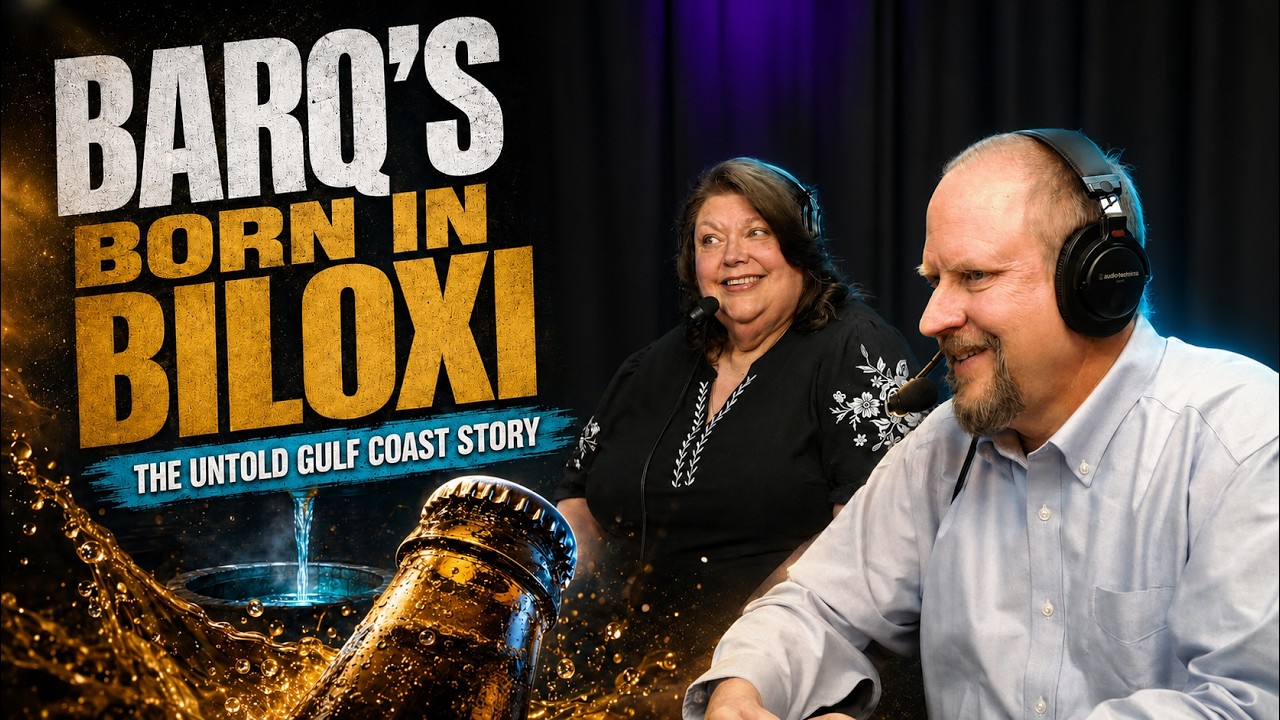
Most people on this coast grew up on Barq’s without ever knowing the building where it started is still standing in Biloxi.
The white wood frame building on Keller Avenue spent most of the last century as storage, then as a restaurant painted solid pink, then as a wreck that Hurricane Zeta nearly folded into the sidewalk. Nobody driving past would have guessed what had happened inside it.
Now it carries a name that says it plainly, the Birthplace of Barq’s Bed and Breakfast, and the story behind that name starts with a man who never set out to make soda at all.
🧪 The chemist who wanted to bottle champagne
Edward Barq Sr. was born in New Orleans, raised in France and formally educated in Bordeaux as a sugar chemist. What he wanted to bottle was fine wine and champagne.
What he actually bottled, in the French Quarter alongside his brother Gaston, was an orange drink called Orangine, made with juice from the Louisiana Hamlin orange because that variety grows well in this part of the country. It won a gold medal at the 1893 Chicago World’s Fair, a medal stamped with Christopher Columbus for the anniversary of his landing.
Then Gaston died. Barq had just married, and for whatever reason he left New Orleans for Biloxi, where he bought the Biloxi Artesian Bottling Works, an existing outfit that bottled artesian water. Thomas Quave, his great grandson, and Terese Nicovich, who owns and operates the bed and breakfast in that same building, keep coming back to the same picture: a French-trained chemist with a gift for flavor, filling water jugs on the Mississippi Gulf Coast.
Most of the early work had nothing to do with soda. He bottled water in large bottles and made pasta in a building out back, and his main customers were the shrimp boats, because pasta kept without refrigeration and schooners stayed out for long stretches. The root beer came shortly after and sold slowly at first, so the pasta carried it. World War I ended that. He couldn’t get the Russian wheat he liked, sold the equipment to a family in New Orleans, and by then the root beer had taken off.
He never called it root beer, either. The sign on the front of the building read Barq’s Pop, Jersey Cream, and Jersey Cream was a different drink entirely.
🚚 The ten-year-old running deliveries
His son grew up inside that business. In a photograph of the plant from around 1910, a delivery wagon sits out front, the jackass wagon as the family called it, and Thomas’s grandfather, Edward Barq Jr., was about ten years old when he started hauling root beer in it as far as Vancleave, sleeping underneath it with a blanket when a run went overnight.
One of those trips nearly ended him. He crossed the original back bay bridge, a wooden one, and stopped at a hardware store in D’Iberville for crackers and provisions, where the man behind the counter told him a hurricane was coming and he had to turn around. The boy argued that his father would be angry if the delivery wasn’t made. He turned back anyway, with it already blowing sideways, and a shrimp boat that had broken loose came through the bridge just behind him.
That kid became the company’s financial mind. Everybody bottled in eight ounces then, and Barq Jr. was the one who told his father they could bottle 12 ounces, sell it for the same price and still make money. The family understands Barq’s was the first carbonated beverage bottled that way, and the rest of the industry followed.
The first of those bottles came from the Fabachers, who ran a beer brewery in New Orleans, and the diamond pattern bottle Barq’s later designed was modeled closely on theirs so that people in Biloxi and New Orleans would recognize the shape on sight.
📈 From a hand-capped bottle to 22 states
For all that, the work stayed astonishingly hands-on. From 1898 until 1936, every bottle was filled and capped by hand at the Keller Avenue bottling house, with the ingredients kept in a loft and gravity fed down through tubes, water added last.
By 1936 the business had outgrown the place. The family bought a former Ford dealership on the north side of Lameuse and the railroad tracks, in the heart of the city near City Hall and the library, and turned it into what was then a state of the art mechanical plant. That plant was still bottling into about the mid-80s.
Franchising grew through the 50s and 60s, though the syrup was always made in Biloxi and shipped out for franchise bottlers to mix with water and fill. By the time Coca-Cola acquired the company there were 22 states, mostly east of the Mississippi River. Before that it had been sold to two men from New Orleans who held it about ten years, with a fourth generation of the family still working in the bottling.
The family never held the formula itself. Boards pulled from the bottling house carry Barq Sr.’s handwriting, a sugar syrup base rather than the root beer recipe, and those boards were saved before the renovation began.
🔨 The building that was going into the street
Back on Keller Avenue, the original bottling house went quiet. After 1936 it was storage, plain white wood frame, until Thomas’s Aunt Lucille opened Lucille’s restaurant in it through the 80s and painted the whole thing pink.
Thomas had gone in on the building years before with his cousin Robert Bones Barq. They sold it to people who meant to put a business in, that fell through, the building came back, and then the hurricane hit. By then Thomas was sole owner of, as he puts it, “this building that was about to fall into the street”.
Two people had already made sure it wouldn’t go quietly. Chelsea Prince and Tanya Darrow worked to get it onto the list of most endangered historical sites in the state of Mississippi, which opened the way for an excavation of the property. Some of the bottles now on display came out of that ground.
Saving it took about five years and no plan at all. Andrew Alexander, a builder and a descendant of Laz Lopez, looked at the wreck and said it could be done. The roof trusses came off and were set aside, the frame was straightened, a new foundation went underneath, and the whole building was moved six feet back because the front had been built right on the sidewalk. The front wall and both side walls are original; the back wall had too much rot left to keep. The steps out front are built from the bricks that were the building’s original pilings.
Three of the four walls in the main living area are the building’s own 1800s wood, and the kitchen is paneled in the original roof boards, nail holes and all. Terese does not oversell it: “You really do walk into history.”
lay your head down in history
Terese, Birthplace of Barq’s Bed and Breakfast
🛏️ A living museum with beds in it
The bed and breakfast was Terese’s idea, and Thomas turned it down flat. Two years later he called her back and asked her to put something on paper, and Thomas allows that “her plan looked better than my plan”.
Three suites are named for the three granddaughters of Edward Barq Sr., and the premier one sits up in the loft where the syrups were once mixed by hand. Downstairs, one wall holds bottles going back to 1898, another carries portraits of the five family members across the first three generations who built the company, and the south wall tells the story of the building itself in photographs, decade by decade. The kitchen belongs to Aunt Lucille, with the oyster bar sign from her restaurant hanging above the sink.
Terese, a retired teacher with 37 years in, is the one cooking, and she puts the whole undertaking simply: “It’s a way of life.”
The building is finished and she has already moved in. Reservations are expected to open within 60 to 90 days, with the holidays the target, and the website is built but held back until bookings can be confirmed, so names are penciled in through the Facebook page and the business line. Once it is running, one Wednesday a month goes to free private tours by appointment, and she intends to fit in one school group a month, also free.
The beach is 150 yards from the front door. From the kitchen window you can see across to Deer Island, and at sun up and sun down, pelicans diving for fish.
Thomas’s reason for any of it is straightforward. Plenty of people in their 50s, 60s and 70s remember when Barq’s was made in Biloxi, while younger ones often have no idea their city has claim to being the birthplace of it. “I don’t want that to go away,” is how Thomas frames it, and a building people can walk into is harder to forget than a fact in a book.
That is the quiet argument this place makes for the whole coast. A family arrived here after a death in New Orleans, not knowing what would come of it, and left behind a drink people still order by name and a wood frame building that outlasted the plant, the pink paint and the hurricane.
Want to Be Part of the Pelican Gang?
Check out our merch here. Download our free app: Apple · Android. All our links: linktr.ee/Brownwaterb