
The hardest math in the Biloxi charter fleet is not finding fish — it is what is left over once the tanks are full.
That math is why a six-hour snapper trip looks different from the dock than it does from the tower, and why one captain runs two boats instead of one. The big one is comfort and range. The little one is cheap to move and easy to fill on short notice.
It also explains a lot of the quieter decisions out there — the limits a captain cuts on himself, the trips he will not sell in December, the pivot to amberjack when the snapper calendar goes soft. Eleven years in, a lot of the job is not about catching fish at all.
🎣 A license the day he was old enough to hold one
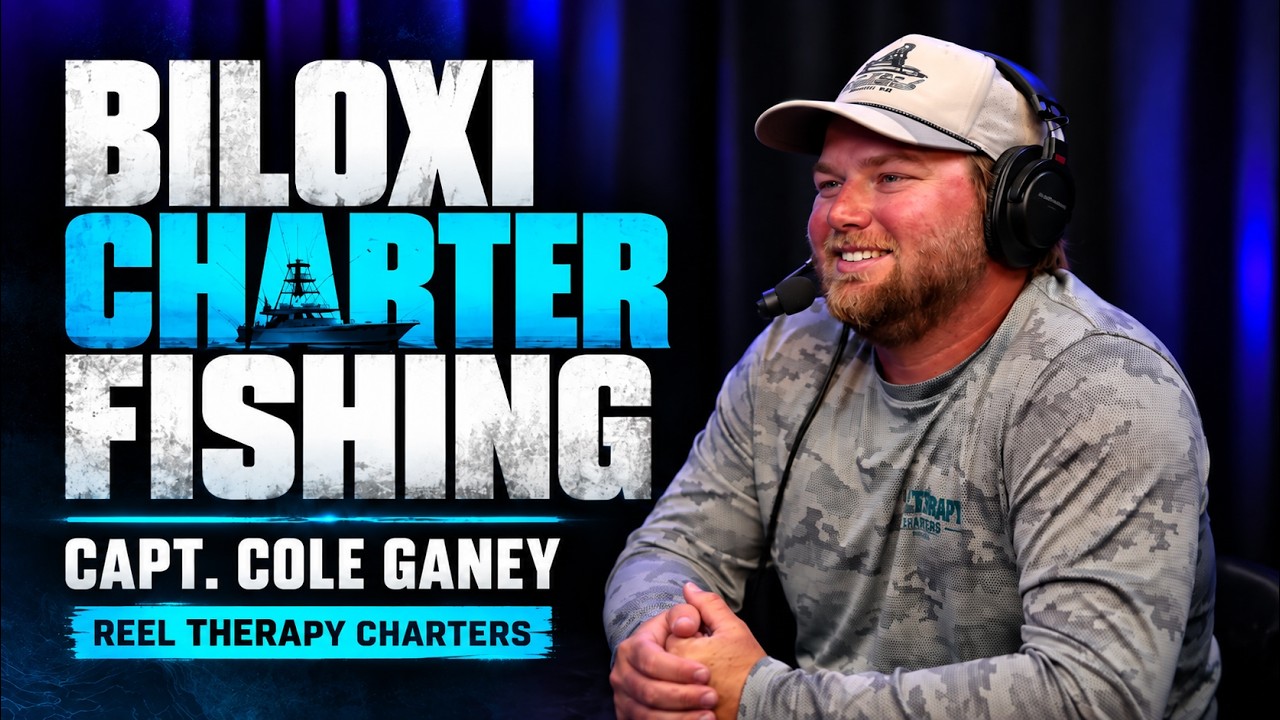
Captain Cole Ganey, who runs Reel Therapy Charters off the B block docks in Biloxi, got his captain’s license the year he was legally allowed to. Eighteen is the minimum, and he went and did it as soon as he turned eighteen. Born and raised on the Mississippi Gulf Coast, he had already worked out what he wanted to do while his buddies were off having fun in high school and he was working every day.
He took the sea school route and drove about forty-five minutes each way rather than staying over, which he would change if he did it again — by the time he got home he did not want to look at the book. It is a hard test, and the place runs like a barracks: wake up, eat, class, eat, sleep, every day. On that drive he kept noticing the same car making the same turns as him. It turned out to be Seth Ward with Sea Tow, and the two of them could have carpooled the whole way.
The saltwater bug came earlier than the license. His parents kept a condo in Orange Beach through his tenth grade year, a cousin married a charter captain fishing out of Zeke’s Marina, and any chance he got he was on that boat deckhanding by fourteen or fifteen. Before that it was mostly freshwater — catfishing with his grandpa up in Alabama — plus a week of sea and sail camp every summer at home.
His first deckhand job on this coast was with Bill Dominator on a little Mako, back when mackerel ran thick enough that cleaning fifty or sixty in a day was nothing. From there he filled in on the Silver Dollar, spent eight or nine years working with Jay, ran the Silver Dollar for three good seasons, and slowly moved to full time. He is twenty-nine now, eleven years into it.
That apprenticeship shows in how he handles his own crew. Captain Ganey will admit he is a drill sergeant, but says he never asks for anything he did not get himself: “I want you to be the best you can be.”
⚓ Two boats, two different jobs
The boats he learned on are not the boats he runs now. He bought a 36-foot Topaz two years ago in the fall and named her Reel Deal, and this was his second summer on her. She runs twin Cummins 450s, has a tall tower he is known for around the fleet, and — the real ace in the hole in a Biloxi summer — air conditioning, a head and a couch down below.
That matters more than it sounds. Biloxi runs on bachelor trips from guys whose wives would not sign off on Vegas, and a brutally hung-over group that can go lie down in the cool and wake up around noon is a group that finishes the day. The boat takes six people, which he says is good and bad.
The 21-footer is a different business entirely. Two or three anglers is gravy, four is his ceiling, and he does not want to be out on her longer than four hours — if they are biting, it happens inside that window. In the spring she runs two-hour white trout trips along casino row, which costs about five dollars in shrimp and a little ice and almost nothing in fuel. When the white trout got hammered, he turned that same short trip into a family run for five- and six-year-olds whose parents have no idea how long the kids will last: keep enough for lunch and carry it up to the Ole Biloxi Fillin’ Station to have it cooked.
He will run the little boat in December too, though he tells people what they are getting into. Winter fishing goes to extremes — outstanding or dead, with nothing in the middle.
I’m not in it to take your money
Captain Cole Ganey, Reel Therapy Charters
🐟 The fish nobody used to want
The fish that carries his spring is one people used to throw back. Sheepshead were a trash fish on this coast, and now they are the main game in town from March on, because attention spreads fast. Triple tail went the same way — almost nobody targeted them until the internet found them.
Ask him if the sheepshead limit is too high and the answer is immediate: too high, or at least high enough that more guys need to regulate themselves. He keeps twenty per boat in the spring and will not clean more than that in the fall either. The most he ever cleaned in one go was about thirty, and he remembers what it did to his thumb and his elbow.
What he cannot regulate is the cast net crowd. One person with a net can wreck an entire pile of fish in a morning, and the ones doing it are out there day in and day out, rolling right on top of boats that are already fishing. He posted a video about it and got ganged up on in his inbox. There was a bigger operation at one point too — fish going out by the truckload to Georgia — because sheepshead move easily, often as somebody else’s snapper.
Captain Ganey has had the two laid side by side with the bloodline cut out, and he is blunt about it: “You cannot tell the difference.” He is also partial to turning them into crab cakes, which tells you how far the trash fish has come.
⛽ Sharks on every drop, and $2,100 in the tanks
What he cannot self-regulate at all is what is already down there eating the catch. He has started running amberjack trips, something only a few Biloxi boats do, and the ride is three to three and a half hours each way. The Topaz has hit 31 knots, but he cruises at 20 to 23 to save engines he needs to last a long time.
On a recent Saturday amberjack run, the sharks and barracuda hit on every single drop and the boat came in a few shy of its limit. As Captain Ganey put it, “I’ve never in my life seen sharks this bad.” His read is that a shark limit barely matters against those numbers — anyone who has sat behind a shrimp boat lately knows what is down there.
Then there is the fuel. The big boat holds 175 gallons a side, and filling all 350 runs about $2,100 at diesel prices that had been pushing six dollars before easing off. He never lets it get below a quarter. He went back and forth all season on whether to add a fuel surcharge, did it a little and probably not enough, and figures next year is a set price plus fuel — the way the tuna boats have long handled it.
Asked what a busy summer actually leaves behind, Captain Ganey does not dress it up: “I collect a lot of money, but it all goes out the exhaust.” By his own reckoning, the late-summer trips cost him more than they brought in.
📱 Filling the book without a middleman
Covering that overhead comes down to who is calling, and most of them now come straight through his own website with online booking, which matters when he is offshore with nobody answering the phone. Across both boats he ran under ten trips all year off Fishing Booker, and exactly one of those was on the big boat.
He is not knocking the platform. A new captain with no clients has no other way in, and getting off it only works if you have spent years building a base — and only if everybody does it. His sister-in-law, Laney Miller, handles his social media, and stays on him for fresh content when he gets too busy driving to shoot any.
The people booking come from Birmingham, from Meridian north all the way to Tupelo, from the Atlanta area, and in spring from Michigan and Wisconsin — snowbirds who show up in t-shirts and shorts at fifty degrees insisting it is nice. Being on B block put him in front of walk-up traffic for the first time in two years, after seasons tucked behind the Golden Nugget with Jay and Maddox where nobody wandered past. A cleaning table in view of foot traffic, he says, is worth its weight in gold.
His deckhand, Cooper Kaplan, turned twenty-two in August and has been with him since the start. “I’m hard on him, but he does a good job,” Captain Ganey said — the same deal he got when he was the kid on somebody else’s deck.
Nothing on that dock really works alone. When a boat is booked in summer, the captain sends the call down the line to the next one. When the structure offshore thins out and the spots go cold, everybody feels it in the same season. And when a fish like the sheepshead goes from throwback to headline in a few short years, the only thing standing between it and a hard decline is a fleet of captains quietly agreeing on a number lower than the law allows.
That is the part most people never see from the parking lot — the self-imposed twenty, the trip not sold, the engines run at cruising speed so they last another decade. The fishing on this coast holds up, when it holds up, because of decisions like that made one boat at a time.
Want to Be Part of the Pelican Gang?
Check out our merch here. Download our free app: Apple · Android.